
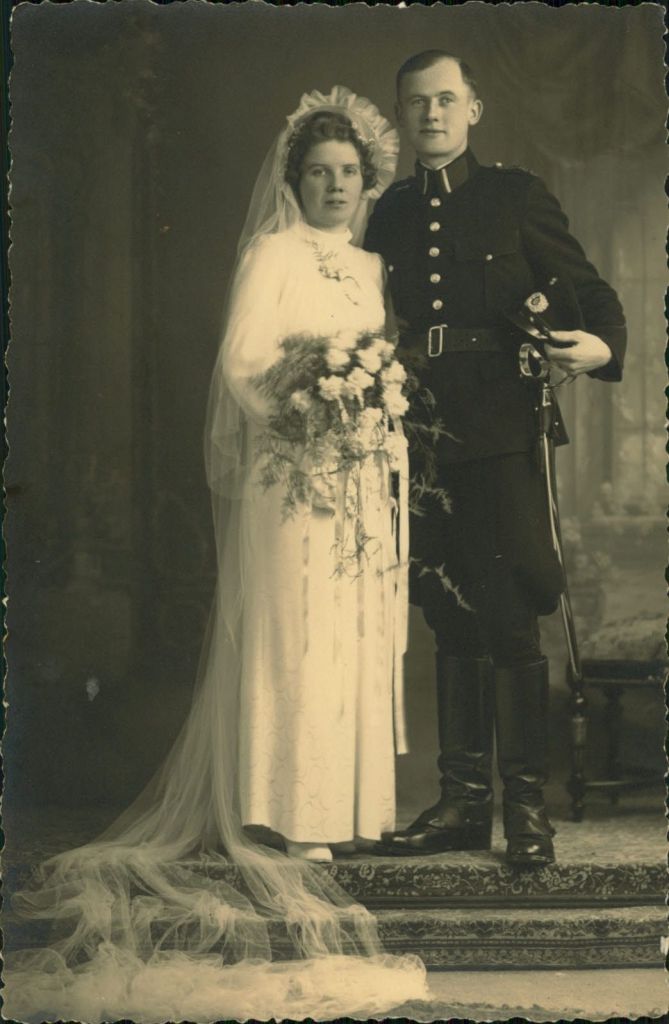
My father (1920 – 1995) was a young policeman in Amsterdam in the Second World War. He married and had two children, one born in 1945 before the war ended. He was confronted by very difficult choices.
My grandmother Margiena Koops, on the other hand, living in Drenthe in the Netherlands, sheltered and cared for a young Yewish boy during the war years. Hundreds of little children were smuggled out of care centres and schools to a safe place and their identities changed, when their parents were roughly hauled from their homes as in Amsterdam and deported to concentration camps. My grandfather Harmannus Luinge, was not happy with sheltering a boy because he was presumably frightened of possible repurcussions if they were found out.
“When Dutch Jews were rounded up for deportation to concentration camps, in the Netherlands in 1942, a plan was hatched to sneak hundreds of Jewish children out of a Jewish daycare to safety with “foster families” in the countryside. From survivors’ stories to rescue workers’ heroic tales, this well-organized, subterfuge of a resistance movement is the hidden history of World War II heroes and heroines during the Holocaust. ” AngelsofAmsterdamFilm.
http://en.wikipedia.org/wiki/Netherlands_in_World_War_II
Dutch Forced Police Involvement by the Nazi’s in WW2
Position of the Dutch within the Nazi ideology
Another aim of the German occupiers was to dissolve the Dutch nation and make it part of a greater Germanic, or Aryan, one. The German officials, including those of the SS, Arthur Seyss-Inquart, and Adolf Hitler himself regarded the Dutch as part of the Aryan Herrenvolk (master race).
Shortly after it was established, the military regime began to persecute the Jews of the Netherlands. In 1940, there were no deportations and only small measures were taken against the Jews. In February 1941, the Nazis deported a small group of Dutch Jews to the concentration camp Mauthausen. The Dutch reacted with the February strike as a nationwide protest against the deportations, unique in the history of Nazi-occupied Europe. Although the strike did not accomplish much—its leaders were executed—it was an initial setback for Seyss-Inquart as he had planned to both deport the Jews and to win the Dutch over to the Nazi cause. Prior to the February strike, the Nazis had installed a Jewish Council: a board of Jews, headed by Professor David Cohen and Abraham Asscher, who served as an instrument for organising the identification and deportation of Jews more efficiently,[citation needed] while the Jews on the council were told and convinced they were helping the Jews. In May 1942, the Nazi leaders ordered Dutch Jews to wear the Star of David. Around the same time the Roman Catholic Church of the Netherlands publicly condemned the government’s action in a letter read at all Sunday parish services. Thereafter, the Nazi government treated the Dutch more harshly: notable socialists were imprisoned, and, later in the war, Roman Catholic priests, including Titus Brandsma, were deported to concentration camps. In 1942, a transit camp was built near Westerbork by converting an existing internment camp for immigrants; at Vught and Amersfoort the Germans built concentration camps as well. Eventually, with the assistance of Dutch police and civil service, the majority of the Dutch Jews were deported to concentration camps.[2]
Oppression
Arbeitseinsatz — the drafting of civilians for forced labor — was imposed on the Netherlands. This obliged every man between 18 and 45 to work in German factories, which were bombed regularly by the western Allies. Those who refused were forced into hiding. As food and many other goods were taken out of the Netherlands, rationing (with ration cards) became a way of controlling the population. Anyone who violated German laws, such as hiding or hiding another, automatically lost his or her food ration. At times, the resistance would raid distribution centres to obtain ration cards to be distributed to those in hiding.
The Atlantic Wall, a gigantic coastal defence line built by the Germans along the entire European coast from southwestern France to Denmark and Norway, included the coastline of the Netherlands. Some towns, such as Scheveningen, were evacuated because of this. In The Hague, 3,200 houses were demolished and 2,594 were dismantled. 20,000 houses were cleared, and 65,000 people were forced to move. The Arbeitseinsatz also included forcing the Dutch to work on these projects, but a passive form of resistance took place here by working slowly or poorly.
For the resistance to succeed, it was sometimes necessary for its members to feign collaboration with the Germans. After the war, this led to difficulties for those who pretended to collaborate when they could not prove they had been in the resistance — something that was difficult because it was in the nature of the job to keep it a sec
Recruitment poster for the SS with the slogan “For your honour and conscience! AgainstBolshevism! Enlist in the Waffen SS.”
See also: National Socialist Movement in the Netherlands and Nederlandsche SS
Not all Dutch offered active or passive resistance against the German occupation. Some Dutch men and women chose or were forced to collaborate with the German regime or joined the German army (which usually would mean being placed in the Waffen-SS). Others, like members of the Henneicke Column, were actively involved in capturing hiding Jews for a price and delivering them to the German occupiers. It is estimated that Henneicke Column captured around 8,000-9,000 Dutch Jews who were ultimately sent to their death in the German death camps.
The Nationaal-Socialistische Beweging (NSB) was the only legal political party in the Netherlands from 1941 and was actively involved in collaboration with the German occupiers. In 1941, when Germany still seemed certain to win the war, about three percent of the adult male population belonged to the NSB.
After World War II broke out, the NSB sympathized with the Germans, but nevertheless advocated strict neutrality for the Netherlands. In May 1940, after the German invasion, 10,000 NSB members and sympathizers were put in custody by the Dutch government. Soon after the Dutch defeat on 14 May 1940, they were set free by German troops. In June 1940, NSB leader Anton Mussert held a speech in Lunteren in which he called for the Dutch to embrace the Germans and renounce the Dutch Monarchy, which had fled to London.
In 1940, the German regime had outlawed all socialist and communist parties; in 1941, it forbade all parties, except for the NSB. The NSB openly collaborated with the occupation forces. Its membership grew to about 100,000. The NSB played an important role in lower government and civil service; every new mayor appointed by the German occupation government was a member of the NSB.
After the German signing of surrender on May 6, 1945, the NSB was outlawed. Mussert was arrested the following day. Many of the members of the NSB were arrested, but few were convicted; those who were included Mussert, who was executed on May 7, 1946. There were no attempts to continue the organization illegally.
In September 1940, the Nederlandsche SS was formed as “Afdeling XI” (Department XI) of the NSB. It was the equivalent to the Allgemeine SS in Germany. In November 1942 its name was changed in Germaansche SS in Nederland. The Nederlandsche SS was primarily a political formation but also served as manpower reservoir for the Waffen-SS.
Between 20,000 and 25,000 Dutchmen volunteered to serve in the Heer and the Waffen-SS. The most notable formations were the 4th SS Volunteer Panzergrenadier BrigadeNederland which saw action exclusively on the Eastern Front and the SS Volunteer Grenadier Brigade Landstorm Nederland which fought in Belgium and the Netherlands.[22]
The Nederland brigade participated in fighting on the Eastern Front during the Battle of Narva, with several soldiers receiving the Nazi Germany’s highest award for bravery.
 hermienzwiers.com
